martes, 27 de marzo de 2018
The Road To The Stage
By ChulucanasGym
The look of wrestling celebrities inspired Henry hernandez to sign up a gym. "If they can, maybe I can". He was 18 years old then. Today he's 29.
The first time he contested was in 2013, in Chulucanas, Peru, the city he born and where he lives currently, after checking out many magazines and movies about Arnold Schwarzenegger. "I was wondered of the body's aesthetics," and in Arnold's case, he thinks his best body part is his chest, no question about it.
Lesson 1: Give Up On Your Shame and Fear
One of the thinhgs he had to bear was the people bringing him down, but he learned soon to take that easy. "Everything I heard, it went in an ear then went out the other one. I just listened to my body, moving me forward."
Another thing he had to bear was standing up semi-naked on the stage before the public, but when he watched the other contestants did it untroubled, he felt some relief. "I'm very nervous, so I watched the other contestants performing without much complication, and I tried to control that fear for following the protocols ," he confesses.
[READ also: Our 11 tips when you're looking for a sponsorship.]
Something worst than that? Yes! That you forget about your choreography and the poses you had planned to do. "I just had to concentrate myself by looking at the judges, or I closed my eyes avoiding to see the audience, I got focused on my technique to be well performed."
Henry says as the time passed by, he has come to work about that topic, so he hopes the next times he have to contest, he will superate the fear, that is natural in the other side. Even, experienced artists say to feel it every time they have to stand up on the stage. Inclusive, it's a signal they are doing the things right.
The mental work of a contestant is so hard, as the physical one, because has to bear these situations, too many usual among who contest. They also have to work much their attitude, that reflexes into their moves fluency on the stage, and ever keeping in mind to enjoy the time a lot, even when it's about a competition. Staying up there is already a high task.
[READ ALSO: The strategy of René baró for reaching real goals.]
Lesson 2: Internet is almost never right
The first time he decided to contest at Mister Piura, a state-wide contest, was in 2014, and he started to look for information on Google to design his training strategy, but he didn't get the results he expected.
Then he understood something: what the search engines highlight is not ever true. For example, that the last days he had to elliminate the sodium, and he ended holding liquids back. "Ones said one thing, others said another thing," Henry remembers. "The truth is I cannot put my health in risk."
Actually, the Internet doesn't lie although it might say the truth first. What you have to do is gathering all relevant information you can, to compare it, and to verify it with recognized and certified sources. Sometimes it's better to delay many days until having the full information than getting excited about what appears the first 10 seconds of research.
"Now I follow the people who had contested and the appropriate sources," Henry affirms.
In ChulucanasGym's case, we have a protocol useful for you: once we gather all our data, we consult them with scientific sources to determine what are true, what are myths, what must be handled carefully; we discard the two last ones, and we only stand up and publish what is a scientific truth and preferently independent because many comes commercially polluted.
[READ ALSO: Henry's 5 steps for a correct warm-up.]
Lesson 3: The Body Doesn't Only Live From Weights
In the physical level, the training and the feeding are two key aspects to care.
"I have to manage a diet that fits me because not all the bodies are equal," Henry tells. The common to all the bodies is indeed all the diets have to balance proteins, carbohydrates, vitamins in right ratios.
If you have access to a nutritionist, you'll can get help to create a regime made according to your needs.
Henry also eats 5-6 times per day "for the body to be metabolically active, [plus¡ much fruit, much water."
The last week before a competition, reduce the ingestion of carbohydrates although increase the frequency of consumption. Every two hours in Henry's case. Likewise reduce the consumption of potasium and water at the point that the last day almost don't drink liquid.
"Gotta see yourself rocky," Henry points out.
[READ ALSO: The importance of a healthy feeding.]
The another aspect is compplying rigorously your training routine. The idea during the first weeks is building muscle and stabilizing its volume as it grows up. Usually, it's about exercises with much weight and short repetitions.
The previous weeks to a competition, the scheme changes. "I do hypertrophy exercises with low weight and many repetitions, or pumping-up exercises to keep, for it to see more ripped," Henry explains.
In the last weeks, much-weight exercises are not done longer, because you won't gain muscular mass yet.
Remember that two tools you ever got to have ready are the measuring tape for controlling progress in an objective way, over body measures, and a weighing machine that doesn't lie, for controlling your weitht and being sure you belong to the cathegory in what you plan to contest.
[READ ALSO: Do you know what your genetics is?]
Lesson 4: Get everything Ready
The competition day usually divides in two parts: weight control and the performance itself. be aware you have in your hands everything you need for each one of those phases.
If somebody can helps you for not carrying on everything everywhere, and relief you to take off a reason to concern by the way, will be the best.
If you are one of those who uses to forget the things in the last minute, make a written list on a copybook or your cellphone, then write down everything you need, so when you have to carry it on, you check it out. Of course, don't forget the copybook or the cellphone.
If you learn to organize, everything will be easier.
Lesson 5: Don't Give Up
Despite all this preparation, Henry didn't get any price in the last contest he entered. What went wrong? According to him, his preparation was right but he wasn't clear about which one the judges criteria were at the qualification time.
Many contestants use to react angry when the results are not favorable to them. It's natural. But also remember there can be many personal, external factors those don't generate a victory.
Superate the angryness, pass over the time, continue training consciously. The worst that a sportsman can do is giving up. He is not done for that. It is not into his DNA. Then, continue superating, set up new goals, contest again.
[READ ALSO: The 7 tips of Pedro Bautista for being better in sports and life.]
Remember almost never the triumph comes in the first time you try, but neither expect to get something if you never try it. They can defeat on the stage, but they never won't defeat on your attitude.
miércoles, 18 de noviembre de 2020
lunes, 9 de mayo de 2022
Tips before your retirement
If you leave to work out or compete for the lifetime, don’t slam on the break – program how to manage the transition.
Although it seems, nothing’s eternal, and for some bodybuilders and athletes this means they decide to stop their training somewhen in their lives whether to hold the body shape or being prepared for a competition.
Almost never it’s Good news
but the reasons bringing them to choose that must be respected, accompanied
whether by a cheering message or the simple fact of being beside as the same
times of achievement, or even glory, as
much as possible
However, it’s not about
stopping and staying in a dead point neither like it would be about a finished
playing. Actually, it’s about a transition. There are some details you must be
aware to do that in the best possible way – coming next, some helpful tips.
Design and apply a plan what doesn’t put your health in risk
When you train constantly,
and much more if that’s about a competition, the metabolism trends to modify
naturally for having the best results – the body stands programmed by the next
charge of activity. If the training stops suddenly, the body Will last
assimilating it, it will continue to hold an optimized metabolism for the muscle to grow
and getting ripped.
It’s almost like the inertia
effect which an object trends to continue its movement although the power
causing it has ceased. That movement is called potential energy. The trick in
the transition time from training to leave training consists in the process
goes doing progressively less intense.
As you set up little goals to
grow weekly, monthly, now you will have to do it reverse in the same time
lapses so the slowing-down doesn’t cause injuries to your health. For example,
heart, kidney failure, sudden increase of body fat,
digestive problems, and especially overweight and even obesity.
Ask a specialized medical
doctor to design a slowing-down plan for your training rhythm and metabolism that
includes you, follow it down .with rigor including the periodic visits to
evaluate results. Remember that worked other person does not necessarily will
work with you because every organism reacts within its own particularity. The
same happened when when you started to work out.
Design and apply a plan for your professional or commercial future
The mandatory question is
what you will do when you leave working out and contesting. If your answer is you
have no idea, this is a good time to think seriously about the issue,
especially if you are a professional bodybuilder or athlete and your job was
basically dedicating to your discipline.
If you have saved money and
you want to invest it in some business that makes you profits, have a careful
advice with somebody who has proven experience in personal finance. If you want
to run a gymnasium (or if you already own one), assure the business model
allows you to control every step and every cent to use (“the master’s eye makes
the horse,” the quote says).
If you’ve studied for a
career and you wish to practice it after your retirement, don’t wait until your
training’s finale to start to look for a job. Send your resumes since before so
you get engaged in the less possible time. Even if you want to work freelance,
its ever good to have a connections network those turn your new clients.
Using your legacy as athlete
or bodybuilder adds points to get a job that has nothing to do with the sports
world? Yes! Many forms admit you to include these facts and many employers or
headhunters are beginning to rank it positively because we trend to be more
competitive, especially at the time to assume new challenges. Then, the
upcoming later could be as favorable for you as what you had to leave behind.
Check here for the next 3 tips. You can also get more advice on our Twitter account and chulucanasgym@gmail.com
jueves, 10 de marzo de 2022
“I do it to feel good to myself”
One of the most becoming-frequent answers in persons who begin any type of training at gym, home, or outdoors, is “I do it because I want to fffeel good to myself.” And they mark aa very clear posture compared to who go with the evident intention of building muscle or simply keeping fit.
The profile of the ones
giving this reason is usually professional people with much job or family load,
empowered during Covid-19 pandemic, which stress levels are high. In this bunch, there are also who
lost relatives or quite beloved people due to the plague that passed away
dozens of million lives around the world.
There’s no much to explain
from the mental health’s perspective. The power of physical exercise as an emotional balance generator is pretty proved because of the simple reason that the
training makes your hormonal segregation to be more efficient, especially that
avoids or controls conditions like depression or anxiety, and rules your metabolism.
“I already sleep once now from 11 at night to 6 in the morning,” a 30-year-old accountant tells us in Tambograndé, Peru, requesting us to be anonymous. If he has played soccer during much time, the untreated anziety has betrayed him almost without warning. “I ate any time, I didn’t sleep good.” From 154 pounds, he raised to more than 220 pounds! And he’s just 5.6 feet height.
After entering a bunch
training gymnastics and functional, he is
losing weight (he’s around 187 pounds), he has noticed his physical &
mental health has improved, add to this that his mood passed from anger to
laugh and calm. However, when we asked him to pose for some pictures, he
declined: “No, thanks – I just do it because I wanna feel good to myself.”
It’s also like a media
specialist in Piura, Peru, 31 years old, 6 feet height, who from 220 pounds,
today it’s 198 pounds… and decreasing. “I don’t work out for the people to see
me or to admire me but because I feel better to myself,” he repeats. And every
morning, he attend to the gym for his dumbells-&-functional routine. And
testimonials like theirs repeat.
If you’re a trainer, you’ve
already noticed it. Perhaps it disappoints you that, unlike other pupils who
really want to improve their physiques whether for competition or
simple vanity, this bunch doesn’t put that goal foreward.
Don’t get wrong
interpretating they are not interested in growing as visible, what they are
really interested in growing inside. Your job, instead criticizing them for not
being like the others or mistaking to compare them to the pretty muscled pupil
of your class, is raising their personal motivation levels, encouraging them to be a better version of themselves.
Maybe sometimes they need to talk to heal, so we remind you how to proceeed in these times.
As much as they receive this
kind of feedback, it’s probable that you progressively go stimulating their sport-competitive
spirit, and themselves to be who go adding greater exigency levels until
reaching similar or better results than your competition pupils or who work out
to look fit. Don’t get surprised if someday themselves ask you to prepare them
for the next tournament.
Comment this in the box below
or write us on our Twitter account. Also contact us at chulucanasgym@gmail.com
jueves, 26 de noviembre de 2020
lunes, 13 de mayo de 2019
You can control this way if your body improves or not
- Shoulders: Take as reference the part where
it is seen more prominent and put there the start line of the tape. Then, pass
it under your two clavicles until arriving to the most prominent part of your
another shoulder. From here, make the tape to run over the upper part of your
backuntil meeting the pointwhere the tape begins. For you to have an idea if
you have taken the measure correctly, if you’re a male and you’re 170
centimeters or 5 feet 7 inches height, your shoulders perimeter should be between
118 to 120 centimeters or 46.5 to 47.1 inches. However, this measure is relative
according to your age, body shape, and sport goalds.
- Chest: Whether you are a male or a female,
take as a reference the part where it is more prominent (probably the nipples
in both cases) and go the tape around you including your scapulas. For the
women, taking this measure will be easy because it belongs to the same like the
bust contour, very required in dressing or beauty contests. If you’re a 170-cm
or 5’7-feet male height, your chest contour could be between 106 and 108
centimeters, or 41.2 and 42.5 inches, but we remind you the measures are
relative, as we clarified you on the previous point.
- Arms and forearms: The biceps and triceps allow your
to know how you are in arms, so you will have to round them at the same time
with the measuring tape and take the reading. If you’re a male 170 centimeters
or 5’7 feet height, it is possible your arms grow until 38 or 39 centimeters,
or 15 or 15.4 inchescontour. In forearms case, take as a reference its most
prominent part and put you the tape around, although this measure is almost
never used.
- Waist: In the males, it’s taken as a reference a
point 3 centimeters or 1.2 inches below your belly button, and in the females,
the zone where it becomes strechest, 2 centimeters or 0.8 inches above the
belly button in general. Then, you take the tape around including the lower
back in the case of males and the medium back in the case of women. The World
Health Organization recommends the males should not be more than 95 centimeters
or 37.4 inches waist contour, and the females no more than 65 centimeters or
25.6 inches, although not much because of a beauty criterion but preventing
many conditions caused by the overweight and the obesity.
- Belly: In the case of women it’s the same
than the taken for waist in men. Basically, it looks to know how much flat your
belly is, in mathematical terms, obviously.
- Hips: In male as well as female, it’s
taken as a reference the most prominent part of your gluteus, rounding both
sides where the pelvic bone is more prominent, passing over your pubis. If
you’re a male (and adding the squads, your genetics helps you too), it is
possible you reach 102 centimeters or 40.2 inches contour if you’re 170
centimeters or 5’7 feet height.
- Thighs: It’s the section of your leg that
begins in your pelvis and ends in your knee. Look for its widest part and round
it with the measuring tape. Look! You have to take just one thigh per
measuring, never both at the same time. If you’re a male 170 centimeters or 5’7
feet height, your thigh can be between 59 and 60 centimeters or 23.2 and 23.6
inches at least, although it’s going to depend on your kind of training. What
is clear, indeed, is that for every 3 centimeters or 1.2 inches of thigh you
get, your arm can not be more than 2 centimeters or 0.8 inches.
- Calf: It’s the part of your leg between
your knee and your ankle. Look for its more prominent part and round it here
with the measuring tape. As equal as the thigh, both calves never must measured
at the same time but one at once. If you’re a male 170 centimeters or 5’7 feet
height, your calf can be 37 to 38 centimeters or 14.6 to 15 inches at least. Yes,
at least.
- Body Mass Index (BMI): Basically, it gives us a more
accurate idea if you are your ideal weight, or if you are overweight or in
obesity. It is calculated by dividing your weight in kilos by your height’s
square. Let’s suppose you’re a male 170 centimeters (1.7 meters or 5’7 feet)
and you’re 70 kilos (154.3 pounds), your BMI will be 24.2 – it’s inside the
healthy. If it would exceed beyond 30,
we could talk about obesity.
- Body Fat Percentage
(BFP): It’s a
more specialized measure that, as its name says, looks for knowing if there is
a healthy balance between the body fat you need for your vital functions and
the fat you store to do your elective functions –we mean- as training. Here
Maths are not enough but we need to use special procedures and devices for
having us a reading. It is obtained by multiplying the quantity of your body
fat by the quantity of your body mass and all that divided by 100. Women will
ever have a BFP greater than men because some fat is reserved for reproductive
functions. About percentages, it is considered that athletes go from 10% to 15%
depending on the physical activity they do. A professional trainer will educate
you about how to control your BFP for optimizing better your training, although
will combine it with diet and improvement in your lifestyle. In fact, it is
probable this catch more attention.
miércoles, 31 de diciembre de 2014
Training Chulucanas Gym Style
miércoles, 27 de abril de 2016
Functional Training
miércoles, 24 de noviembre de 2021
Robinson Ruíz – At least just once in lifetime
Interview by Nelson Peñaherrera Castillo, special to ChulucanasGym. Photographs
Courtesy Robinson Ruíz.
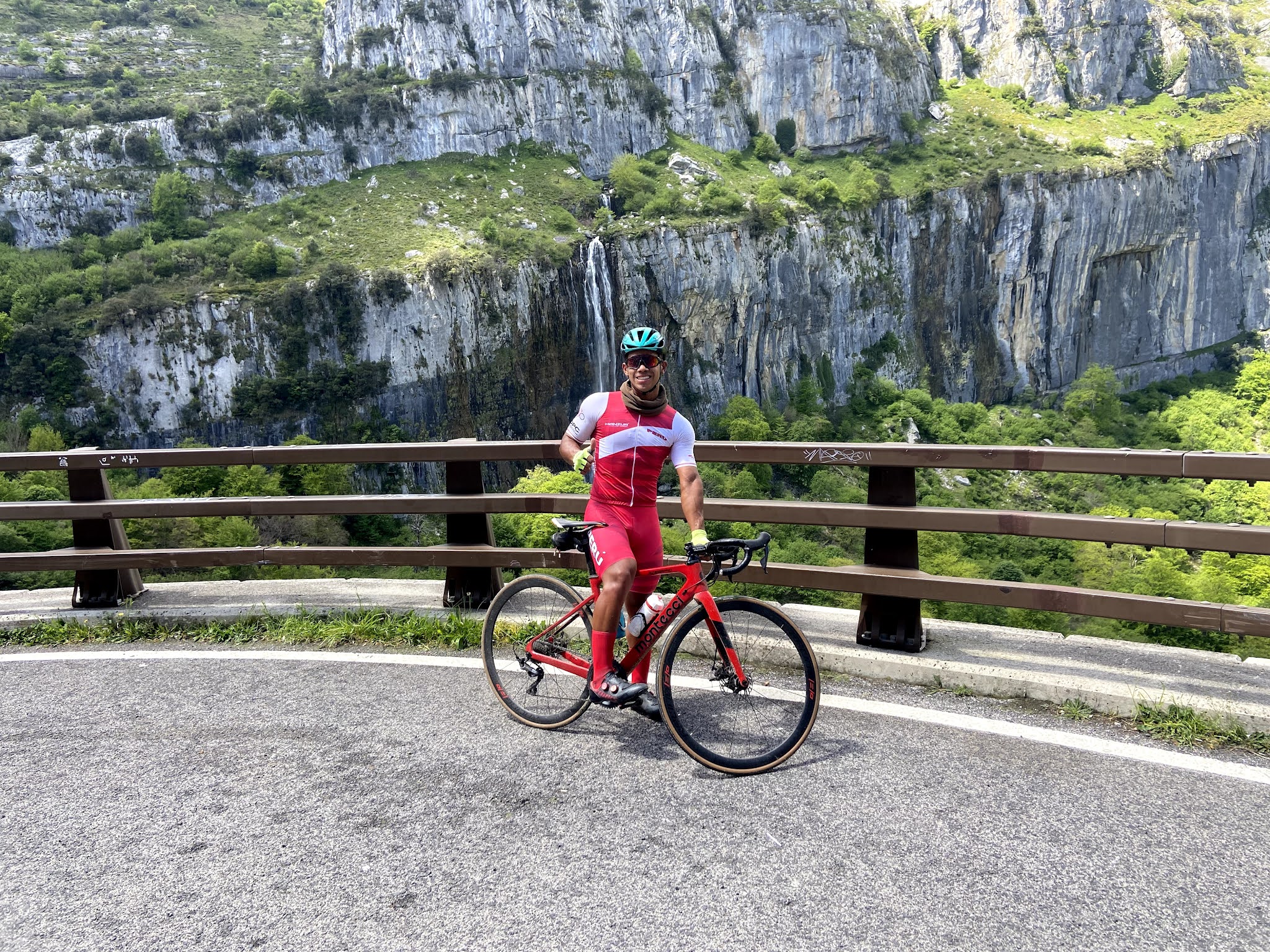
Getting to a very important tournament like the 2019 Lima Pan-American Games costed Robinson Steven Ruíz Calle (Chulucanas, Peru, Sep. 5th, 1998) to stay far away his homeland for training properly, and giving time to extra-sport activities such as working at a restaurant, gathering plastic bottles, or giving maintenance to bikes, but he got it – he got for Peru and for himself, a bronze medal in road biking. His speciality is track speed.
Although he initially trained
at his hometown, he might move to the other side of the nation for perfecting,
in Arequipa, where the High Performance Center is located, and one of the major
biking
hotspots in Peru. In that same place, another highlighted biker trains, his
older brother Hugo Ruíz. Was
all that effort worthy? His name already
appears in the international records of biking. We talk to him while he rests
from one of his most recent competitions.
Since how old do you do
biking, already in competition mode?
Since I was 17 years old.
Have you ever done biking
or have you do other sports?
I began in soccer when I
went to the school, and I also highlighted in athletics, but I felt they
weren’t for me.
So, how do you get to
biking?
Because of my father and
my older brother Hugo, whom I admire much. He began in biking. He did it before
than me.
When you did athletics, what tests did you highlight in?
In 100 flat meters.
And that test is more power
instead of speed, isn’t it?
Yes, it is so.
Then, you have got the
speed and resistance of soccer and you have got the power of 100 flat meters,
and a good leg is necessary in both. How did that help in biking?
So, since I was a child,
I was very disciplined in my trainings, whether in soccer, athletics, or
biking. And I’d add genetics to that, not dismissing the hard work for sure
[laughs].
What factor of your genetics do you believe it plays in your favor?
I think I have some runner skills, reaching good
speed peaks in short distance, and a good power management by Nature, and the
ease to gain muscular mass. I add to that much pure resistance work, resistance
to power and speed.
How do you get to 2019 Lima Pan-American Games?
After a set of selectives
to all pre-selected athletes, who highlighted the most in different resistance
and speed tests were selected. I was one of the chosen ones.
When you arrived, what was
the first thing that came into your head?
The first thing I thought
it was my first and last chance to show the class in home. I like much to do
something thinking it will be the last time I do it. It makes me to deliver
100%.
How much did that
thinking way work to you?
Well, the truth is I
continue applying it in every phase of my life. I believe it helps me ever, it
turned me into a very passionate, dedicated man. It’s about the life is too
short and someone doesn’t know where someone will be tomorrow. The road biking is
a sport that is not respected in Peru by the drivers, there are road accidents
risk ever.
You took an interesting
issue. There are campaigns asking to respect the bikers everywhere, but it
seems the engine vehicles drivers don’t understand it. How do you feel about?
It’s something very sorry
that fills me with much impotence and anger. It’s easy for them to take a seat
in the safety of a big vehicle that protects them. We go on a bike – the only stuff
protecting me is a helmet. I demand respect to the life of us, the bikers –
five feet distance wwhen you want to pass beside me, that’s it. You can lose a
minute of your time and passing in a safe way for us. We can lose our whole
life full of goals, dreams, and along.
Also, the bike produces zero polluting emissions to the atmosphere and it’s a recommended exercise to keep the health of body and mind, isn’t it?
Right, my buddy.
You talked about a life of
dreams and along. Where has the biking got you to, and if did you ever dream at
least to get until there?
Once upon a time when I
was a kid, I dreamed much to be featured on TV riding on my bike with all these
professional bikers who run the tour right there in Europe, and because of the
work and constancy, the biking gifted me that opportunity by participating in
the San Juan Tour, a classic in Argentina where all the professional teams
participate. The dreams are to be accomplished and they can make real, indeed.
I’ve known places I never thought, diverse countries, cultures, moments,
friends, experiences I will keep forever.
Please, mention these
countries, aside Argentina, and don’t forget anyone.
Panama, Colombia,
Costa Rica, Dominican Republic, Venezuela, Spain, Mexico, Bolivia, Chile. These are what I remember.
Almost all Iberoamerica. To
finish for now, I remember when we met your brother Hugo, one of his major
challenges was getting a sponsorship and it was very hard. How was it in your case?
Well, I took a part-time
job a little time ago to fundraise some trips to certain competitions. It still
continues to be a challenge for me [laughs]. I don’t travel to all the rides
because the budget lacks – biking is expensive.
But, do you know what you
have, aside the genetics? So, the pride and the enthusiasm. I hope more people
look at your work and your colleague bikers’ because the international results
you get really makes worthy any funding.
Thank you very much,
buddy.
You can check out the international records of Robinson here. Also, follow him on his Facebook and Instagram accounts.
Do you have a similar story? Write us at chulucanasgym@gmail.com or contact us on our Twitter account.