Mostrando las entradas para la consulta diet ordenadas por relevancia. Ordenar por fecha Mostrar todas las entradas

sábado, 17 de diciembre de 2022

It’s time to set you up goals now

You already got engaged to the training, everything suggests you don’t want to leave it – what it comes up next?


Did the big ones of the bodybuilding & fitness begin being big? Not, they didn’t, definetely. Although there’s no general rule, the most probable is they have begun like wondering, that they have became fond of it when they saw the first results furtherly, and that has made him enthusiastic for going to climb more and more.


Maybe someones decided to go upgrade, they started to compete professionally achieving local, then national, then international titles. At this point, it’s important to say such as achievement were not a gambling result but a strategic planning which steps were accomplished little by little. That’s called achieving goals.


If you just entered the training, you maybe don’t see it so clear. If you have certain time, you could consider it as a possibility. But if you feel you have reached atop, it’s probable you feel everything begins to become routine, no much expectation. And if you get boring, the most probable is you end to leave it.


You need a strategy

The best way to avoid a desertion in short or medium term is set you up goals or progressive and logical arrival points along the time those mean not only physical development but keepers of the wellbeing sensation you have achieved at a first time.


If we have an arrival point, we logically have a starting point, and that is your actual status:  what your actual body measures, what the diet you follow is, what your lifestyle is right now, even your health condition. Anyway, basis information upon a plan can be built. The requirement is this data to be the most honest as you can.


From this basis information, begin the process to set up progressive goals at short-term, medium-term, and long-term. If you have the enough experience by training, take the all necessary time to think and write this plan. If you don’t have that experience, sit down with your trainer alone, begin to outline all. If you don’t trust in your trainer, we leave you our contact later.


But setting up goals is not enough. To reach them, you have to get a set of sequential tasks those take you closer time by time – the training strategy. What routine you will do the first month, what routine you will do the next month, and the next, and so until you reach your goal into a right time.


And around the routine to work you out, what diet you must follow up, what things you must adjust in your lifestyle, and what health indicators you must have in mind. It sounds boring, but when somebody begins to know his body better, this turns a fascinating job. See it that way.


When you get to your first goal, analize what worked to you and what not, what you must strengthen and what you must correct, take your measures again, check the diet, verify your lifestyle, monitor your life condition. If all this give positive results, award yourself and begin to work for the next goal. If you don’t get it, continue fighting and don’t give up.


More practical actions

Although the trainer, if you have one, is the prepared person to guide you in the process, we also advice you have a physical and emotional support that allow you to talk, motivate, not to give up. It can be a training partner, your best friend, a relative, somebody you ever can run to.


About this point, as we ever insist, it’s not recommendable to follow the strategy of other person and apply it like it were yours because two organisms, even being the same kin, don’t react the same.


Ever do the exercise of seeing yourself in the mirror alone and appreciate these little or big changes you go experiencing and assuming them like your achievements. You by yourself Will go telling us what it feels when passing through that experience. Later, we’ll  leave you the ways to contact us.


And, finally, it Will be ever days which we are highly enthusiastic and others we don’t have  motivation to do something. There’s no much problem of the first ones. With the second ones, the challenge precisely consists to overcome the discouragement and begin the training. If you let to defeat by him, even a bit, it will go gaining land little by little and it will go defeating you. And remember – you already got engaged, it’s time to go beyond now.


You can send us your questions or comment us your achievement and wondering by writing us on our Twitter account or at our e-mail chulucanasgym@gmail.com

The photographs featured in this entry have been taken from bodybuilder César Quispe’s Facebook account. 

viernes, 18 de noviembre de 2016

From hobby to local title

How did Mister Sullana 2016 get the triumph?

By ChulucanasGym. Photos by Javier Velasco for El Regional de Piura.


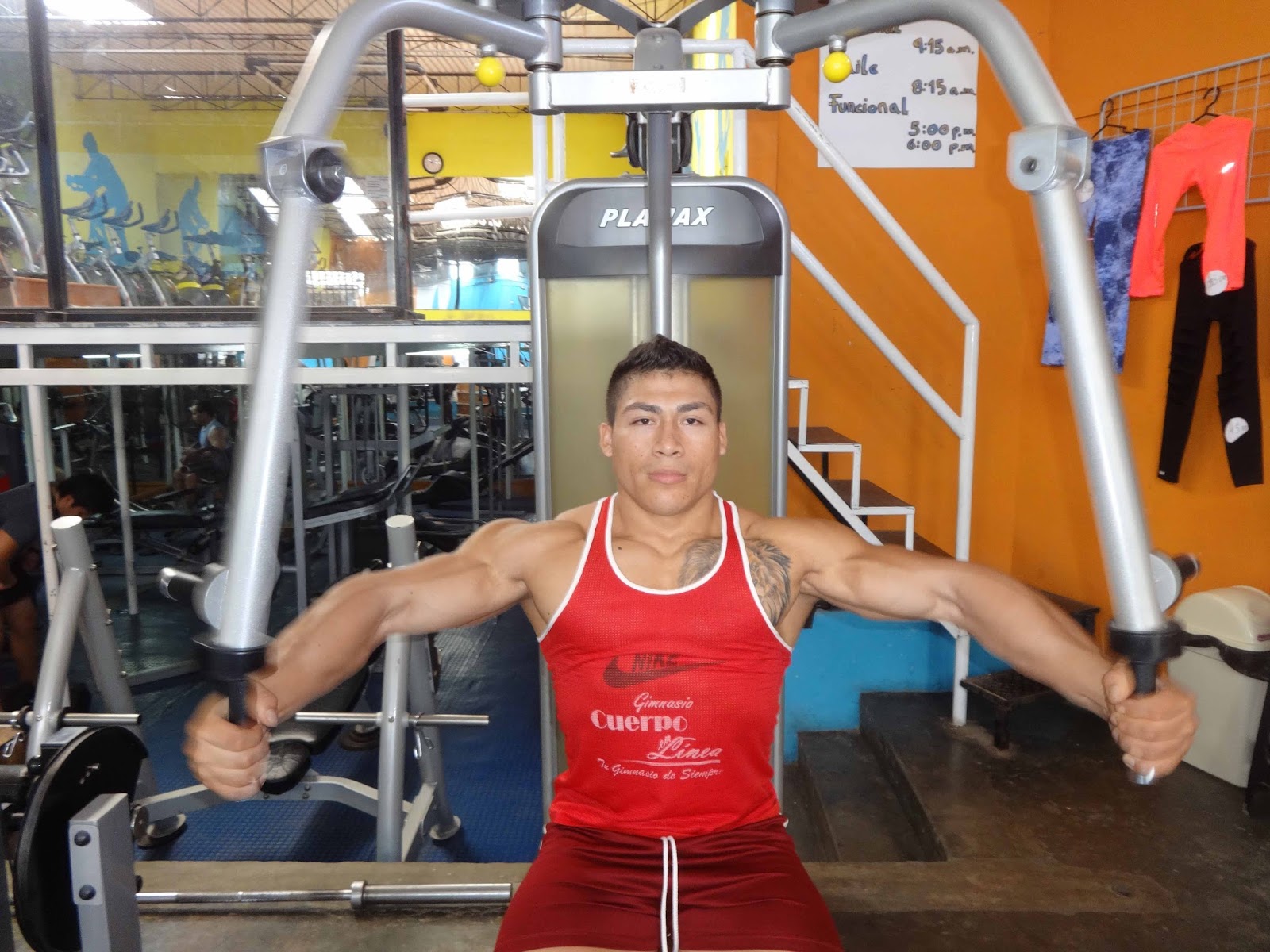
How many years can you take since you decide working out consciousnessly until you get a significant goal? Kevin ericson Cano took nine years since the moment he came into the gymwhen he just was 15.
“Then I was 65 kg, I was too thin,” he remembers. “A friend paid me the class and the trainer said I could be bigger.”

In the beginning, Kevin wasn’t so serious about it, just having it as a hobby. But when he saw how his body muscled, he changed his mind.

“This is my passion today,” he states. “This is what I like.”
- What’s your attitude today?
- Demanding myself more everyday to have my muscles bigger.
- How do you get motivated?
- Training everyday and seeing results, this is a healthy sport because it implies discipline.
Kevin says he consumes supplements as part of his plan, inclusive he sells them for fundraising his training and feeding.

“Supplements give proteins because the diet alone couldn’t supply yet, also the muscles need supplements,” he explains. “Otherwise said, vitamins for recuperation and growing around.”


Today, Kevin is 24 years old, 170 cm height, 85 kg, according to his official record. Coming himself over was not easy - he had his times of doubt but he realised everytime he failed, he had to bring himself up.
“But it only costed me in the beginning, now it’s a lifestyle,” he says.

- What was the hard part?
- The hardest was the diet living in Peruvian Northern. Imagine dismissing to eat tasty food because they don’t supply the nutrients what the body needs, in the other hand, the daily working out, not drinking alcohol, not being awake overnight wwas not difficult to me.

- Do you live expectant of the weighing machine?
- I’m not obsessed about counting calories neither but I do care my regular feeding.
On November 5th, 2016, nine years of training and caring had their first significant goal: Kevin had been declared Mister Sullana’s absolute champion. The next one will be to participate in Mister Piura, scheduled for March 2017.


“My goal is becoming Mister Peru but I have to invest more in diet and working out more,” he assures.
For the moment, the inmediate is fundraising.

“I get funds by giving classes at Cuerpo en Línea Gym where I’m the trainer, plus the gains by selling supplements.” In that sense, Kevin is in contact to a related firm but the things are not so sure. Actually he estimates he will have to double the investing for the national championship than today’s.
Meanwhile, he tries not to miss discipline in his daily life.

“I wake up at 5in the morning, I work at the gym until 1 in the afternoon, I rest until 3 and get back to work until 10 at night, then I sleep.”

He doesn’t’ lose attitude neither.
“Practicing sports keeps me healthy, makes me happy, because I feel agreed for my results,” he points out.


Post-produced by Sheyla Benavente.


sábado, 28 de septiembre de 2024

Fitness for Actors: The Path to a Healthy and Successful Career


Actor Percy Williams
appears in Colán, Piura, wearing a colorful swimsuit and showing an athletic, well-toned body, particularly in his chest, arms, and abdomen. His physique reflects a balance between cardio and strength training, maintaining a healthy condition for his age.


When we think of an actor, we imagine someone who not only plays roles but also radiates health, energy, and vitality. Percy Williams, at 53 years old (turning 54 in February 2025), is a clear example of how fitness can be a fundamental ally for those who want to stand out in acting.


“I've been going to the gym for 20 years,” he says. “I always try to keep my diet healthy; I'm not the kind who meticulously counts calories,” he adds. “I consider the gym a part of my life, which, besides giving me the image you see on screen, also gives me health and relaxation.”


The Importance of Fitness for an Actor: Acting is a profession that demands more than talent; it requires endurance, agility, and the ability to adapt to various roles. Fitness not only helps actors maintain a physical appearance suitable for their roles but also provides them with energy, improves their posture, and enables them to perform at their best during long workdays.


The Mind-Body Connection: Percy Williams knows that being fit is not just about looking good but also about feeling good. Regular exercise releases endorphins, reducing stress and anxiety, which can be common in an actor's life. This mental clarity allows actors to concentrate better on their roles, conveying emotions more effectively.


Physical Preparation for Demanding Roles: Actors often need to undergo physical transformations for a role, whether by gaining muscle mass or building endurance. Being in good shape, like Percy, allows an actor to adapt to these demands more easily, avoiding injuries and meeting the physical requirements of each character.


Practical Tips for Actors Who Want to Start Their Fitness Journey

  • Balanced Routines: It’s essential to work on both cardio and muscle strengthening. This ensures endurance for energy-demanding scenes and strength for more physical roles.
  • Functional Training: Movements involving multiple muscle groups, like those Percy performs, prepare the body for the challenges faced on set.
  • Flexibility and Mobility: It's not just about being strong but also about being agile. Exercises like yoga or Pilates help prevent injuries and enhance the ability to portray characters requiring complex movements.


Nutrition and Rest, Your Best Allies: Percy Williams understands that exercise is just one part of the equation. A balanced diet and proper rest are essential for the body to recover and stay in top condition. Eating healthily and getting enough sleep ensure that an actor is ready to face any challenge that comes their way.


Fitness not only transforms the body; it transforms an actor's career. Percy Williams, at 53, is living proof that regular exercise and a healthy lifestyle can help an actor stay in their best form, ready to shine in any role life presents. Are you an actor or actress? Follow Percy’s example and give your career the boost it needs through fitness! | Follow us on X | Write us by WhatsApp | chulucanasgym@gmail.com 

domingo, 8 de marzo de 2015

Hydratation and more


Water is good inside as well as outside. It’s not a joke neither a word game.
All who work out can’t quit the water consumption, because everyday  we must hydratate and the first reason is our body is  water in a 70% -- blood, another fluids, inner tissues, all type cells and even skin.
It’s clear the daily water consumption we must have is about 2 to 3 litres. As a reference, it uses to say that four glasses equal a litre.
Specialists we asked specify this quantity must be only this liquid. What is contained by food, especially fruits rich in water (as watermelon), don’t go to the final amount but your diet portions, depending on the time you have working out.
Nevertheless water and food is an excellent combination because they transport faster and allow your body eliminates the most everything it doesn’t need anymore, and that can make you sick. That means it’s good for food metabolism plus it regulates  excretionfunctions (sweat, urine, excrement).
In that sense, the water allows the job certain electrolytes (minerals those improve body functions as potasium –K- or magnesium –Mg-) do, happens correctly throughout blood, avoiding muscle wasting.
K and Mg are in food you consume. The water makes easier their transportation by the blood.
Of course, this happens only if your diet and exercise cycles are adequate.
Also, the water is key in a microscopic level for your body’s cells make all their functions on the right time.
Another point on all health specialists coincide is you hydratate around the clock for your kidneys purify the blood constantly.
“if yyou do it once a day, your are going to damage them because it will be a moment they can’t filter the blood and you become to increase their job – then, they’ll get sick,” one of them explained us.

Water and muscle | If you are working out to increase muscle mass, drinking water is mandatory.
Its main function is favoring muscle growing. That doesn’t mean water replaces protein but it does help to be absorbed by the organism so faster , as we told up before.
It’s important you hydratate along the day but more carefully before working out, during working out and after it.
First load must be done 20 minutes before, then during your times between series or exercises. When you sesion ends, you must hydratate inmediatly.
Because you are going to sweat, you need to refill all the liquid you lose for avoiding the body doesnpt work faster and you get tired inmediatly. If you get tired, you couldn’t go through all your routine.
“Its like a car that you put gasoline but you forget lubricant oil,”  a specialist compares us. “Earlier or later, the machine will damage!”
This medical appreciation is opposed to varioous gym trainers’ who recommend  not to drink water during your working out. And we prefer to believe in medical doctors.
Let’s remember that sweating is the process throughout our body holds ideal temperature to function correctly – 36°C, in other words.
There are sports beverages those promise you inmediate rehydratation. U.S. consumers’ reports have pointed out they only have to be drunk even provided you had done intense physical activity, because they are carbohydrates-enriched.If you get them and you don’t need them, they’ll be gathered as useless load in your organism.
Another advice they give is you choose uncolored ones, becausse substances those give it could produce another health problems in the long term.

How to rehydratate? |  We already said that water is esential to rehydratate. Although beverages, jueces, fruits and some solid food contain it, they don’t count on your daily amount. Never forget it.
Coming next, some rules you ever must remember.
  • Drink safe water. In Peru, boil it if you get it from pipelines. If you buy it bottled, get news if your supplier hasn’t been filed because of health problems. You’ll lose much liquid if you don’t care about this issue, and all you’ve got could come down.
  • By the way, it’s better you have your own water.
  • Never hydratate using cool water or a colder one. The rule is  it is quite colder than air temperature, that we usually name fresh water.
  • If you drink rehydratant beverages, take a while to check out the Nutrition Facts, and realize if it won’t produce another undesirable effects.
  • As you sweat the most, you must drink water the most, especially if you get sick. During the production of this story, we have not found any consensus on the specific quantity you have to drink during the day, and as every organism is an apart universe, ,  it’s beter you ask your doctor about your own case, so you can organize your own hydratation strategy. Probably you must drink a glass of water per hour, then increasing it before working out, during and after it.
  • Don’t wait to be thirsty to drink. Specialists coincide thirst is the alert signal your body sends to say “I’m dehydratating”. Even if you aren’t thirsty, drink water.
  • Although alcoholic drinks contain water, the truth is you have forbidden them (especially if you are taking supplements), because your liver and your kidneys consume  your water reserves so faster for compensating you. Also, alcoholic beverages add big quantity of sugar that brings down any training cycle.
And we said when beginning, water is good inside and outside. We already told you priorly – after working out, take a cold bath to stimulate blood circulation.
In winter, hot water is a temptation not to miss the daily bath, however some medical doctors have suggested it accelerates skin aging.
On this point, remember not to waste water while you take a bath. Only use it to get your body wet and to rinse the soap. But having an open faucett without a reason, waste water you even will need in the future. Promote this behaviour among people you work out with, as well at the gym you attend to.
And as working out generates ful-of-germen environments, before handling something to the mouth, wash your hands so good with water and (preferently liquid) soap. A simple 20-second healthy tip that will avoid you lose more water than you require daily.


jueves, 4 de abril de 2019

Do I Tell My Trainer I Have A Pre-Existent Health Condition?


Oscar is 33 years old and works out regularily at the gym, although leaving it for periods due to his work charge. However, he has become a cardio-fan –especially spinning- and he rarely did barbells and apparel.

However, after his last break, he has got back and his trainer put him straight to work out apparel and barbells not considering first the little overweight he was. A month and a half after re-starting his training, Oscar feels he can’t complete the whole routine, he tires very fast, and although he noticed it to his trainer, this one seems not to care about and repeats Oscar he is going to accostum eventually.

Oscar’s family has a diabetes record, a health condition that consists in the increase of glucose levels (sugar) in blood. We know from our experience working out that the glucose provides us the energy we are going to use during our routines and our daily life, and it is usually regulated by the hormone called insulin. So, a person with diabetes is not capable to produce insulin for creating this reaction, so if the glucose levels are not controlled, the person can become to collapse.

Oscar confesses  he already began to make some frequent analysis for determining the diabetes risk, and everything seems to be inside the limits until now. “But my trainer doesn’t know it,” Oscar says. One of the reasons he preferred to ignore this medical fact before his trainer is Oscar thinks his trainer will not know how to process this information, and because his trainer could comment it undiscretionally to not-related people.

The issue is that Oscar would have to warn this information to his trainer, first because of his safety, for the training adapts as it collaborates with the prevention of the diabetes (as his case would be), and the second is if Oscar could suffer any type of related problem, his trainer could not have a plaintiff. However, this is not an excuse.

A Data Policy
Independently from the size and the budget of the gym, having a file with key information of every pupil is necessary: full name, address, contact phone numbers (especially in urgency cases), height, weight, age, and current routine.

If the gym can invest an extra money in documenting information, it could include key clinical data as blood group, supplement the pupil could be taking, if there is any pre-existent health condition, and the record of the suggested routine and diet. Some applications allow to manage this information.

This information is a warrant for the pupil, the trainer, and the gym as well, as much as it is taken as true, and it is taken as a guide for the best training routine or diet to determinelike the most adequate for every person. And let’s remember they must be absolutely customized due to the processes of every organism are quite different each other.

Then, if the gym, the trainer, or the pupil decide to ignore this context by their own side, a simple investigation based on those files will make easier to identify responsible people.

Finally, the trainers who are not managing top-profile athletes should consider that if a pupil warns about a pre-existent health condition, whether it is true or false, what is saying is not an exhausting training is looked for, so the trainer must consider the fact as true, and adapting the exigency to the frame that supposedly has been specified or described. In this case, it is worthy to act slowly despite strongly.

And regarding the Oscar’s claim about an alleged undiscrete conduct of his trainer, he should notice it to the gym’s administration for the corrections to be taken. But every gym must have a clear confidentiality disclaimer that has to be explicit on the document every pupil signs up.

Yes. It could seem too many things to include, but we are talking about human lives, not objects. If you are not clear about this detail, you have no clear what the nature of the physical culture is.


lunes, 13 de mayo de 2019

You can control this way if your body improves or not


Everyone who goes to the gym or does any type of training  is expectant about his or her progress. Have I overcome something I couldn’t overcome before, am I on the same spot when I started, or, in the worst scenario, am not I closer where I started neither?


The problem about measuring our progress is how much objectivity we put to our appreciation. In that sense, the first mistake we use to commit is trusting in the bare-eye, in what we see on the mirror, and almost never the diagnosis we get is reliable. Then, the prognosis we set uses to be wrong.


Is there any objective form to control our progress? Yes, there is. The anthropometrics is the discipline that helps us to have information adjusted to the reality on we can do our analysis and set up our strategies for improving or correcting our physical achievement. This information must be key for your and your trainer at the time to define if it’s necessary to adjust the training routine, the diet, the lifestyle in general, or everything.


Coming up next, we introduce you those key indicators you can control from your home, inclusive, and those will give you that objective vision about what is happening to your body. Look at the data you get – they can’t be taken isolated but grouped. So, the conclusions you arrive and the action plans you take will be more accurate than acting by simple supposition or guessing.


Height
This measure is basic because it serves to calculate other body measures such as absolutes, indexes, and percentages, we will talk about later. You can use a stadiometer, that is the specialized tool in measuring your height, although you can also take the job to paste a measuring tape on the wall or to paint a number scale in centimeters (or feet and inches in the U.S.) setting the ground as the point zero.


Next, take off your shoes, raise naturally, stick your body to the stadiometer or the wall column. Over 20 years old, the height is unvariable for both sexes, at least until the senescence when it can reduce because you will lose bone and muscular tissue.


Body Weight (BH)
It’s a first progress indicator, but alone is not enough because it only will say us if we have increased or have decreased respect to the last measuring. However, it offers us first clues.


The manner of taking it is as easy as put you up on the weighing machine and waiting for the reading in kilos and grams (pounds and ounces in the U.S.). What you have to be careful for sure is  how you take your weight: you ever have to take your shoes off and put on the device; don’t worry about your clothes (if sportswear) because the adding increase is irrelevant, unless you’re a professional or contesting athlete or bodybuilder, and it will be actually necessary you take off almost all your clothes or get naked for having the correct number. Of course, it will depend on how much privacy the place has and how much you trust in the one who could be with you.


The bathroom weighing machines use not to be much accurate as the clinic weighing machines that might be at every good gymnasium. Some electronic devices are only reliable as much as the manufacturer warns it so; then, read the instructions carefully before considering it as reliable and compare many readings taken with different devices to know what is the most accurate. In the same way, we suggest you have a monthly or biweekly record of your weight. Some trainers probably will demand you to have a weekly control if you’re training for a competition. Obbey them.


Absolute Body Measures (ABM)
We call them absolute body measures or ABM because they give us advance or slowing down indicators what only apply to our body as much as parts of it have got wider or have got thinner than a previous control. For that, what interests us is to have countour or perimeter measures expressed in centimeters (or inches in the U.S.), those put in a table give us a mathematical idea of your body volume. Who are dedicated to be models or bodybuilders or athletes know perfectly what we mean. However, a proffessional physical trainer will have here compplementary information to the BW  through he or she can evaluate the effectiveness of the training plan, the diet, or the lifestyle.


The best manner to take these measures  is by using a measuring tape that is put over the skin, not stretching it or releasing it too much, but letting it adjusts naturally to the shape of your body. The precission of the measure gets when the tape makes direct contact with your skin. If there are clothes between them, the excess must be depreciated or definetly avoided. Another trick, if you want more precission, is taking the measure before having meals or starting your training session. And if you still want more precission, take three measures of the same zone and then go to have the average for eliminating the excess or default error.


The measures are taken on specific areas of your body. Remember we need to know the contours, in other words you have to take the measuring tape and round each part of the body, going around it. We are not interested on lineal measures (as taken in dressing), we want to have an idea about volume. The places where those measures are gotten:
  • Shoulders: Take as reference the part where it is seen more prominent and put there the start line of the tape. Then, pass it under your two clavicles until arriving to the most prominent part of your another shoulder. From here, make the tape to run over the upper part of your backuntil meeting the pointwhere the tape begins. For you to have an idea if you have taken the measure correctly, if you’re a male and you’re 170 centimeters or 5 feet 7 inches height, your shoulders perimeter should be between 118 to 120 centimeters or 46.5 to 47.1 inches. However, this measure is relative according to your age, body shape, and sport goalds.
  • Chest: Whether you are a male or a female, take as a reference the part where it is more prominent (probably the nipples in both cases) and go the tape around you including your scapulas. For the women, taking this measure will be easy because it belongs to the same like the bust contour, very required in dressing or beauty contests. If you’re a 170-cm or 5’7-feet male height, your chest contour could be between 106 and 108 centimeters, or 41.2 and 42.5 inches, but we remind you the measures are relative, as we clarified you on the previous point.
  • Arms and forearms: The biceps and triceps allow your to know how you are in arms, so you will have to round them at the same time with the measuring tape and take the reading. If you’re a male 170 centimeters or 5’7 feet height, it is possible your arms grow until 38 or 39 centimeters, or 15 or 15.4 inchescontour. In forearms case, take as a reference its most prominent part and put you the tape around, although this measure is almost never used.
  • Waist:    In the males, it’s taken as a reference a point 3 centimeters or 1.2 inches below your belly button, and in the females, the zone where it becomes strechest, 2 centimeters or 0.8 inches above the belly button in general. Then, you take the tape around including the lower back in the case of males and the medium back in the case of women. The World Health Organization recommends the males should not be more than 95 centimeters or 37.4 inches waist contour, and the females no more than 65 centimeters or 25.6 inches, although not much because of a beauty criterion but preventing many conditions caused by the overweight and the obesity.
  • Belly: In the case of women it’s the same than the taken for waist in men. Basically, it looks to know how much flat your belly is, in mathematical terms, obviously.
  • Hips: In male as well as female, it’s taken as a reference the most prominent part of your gluteus, rounding both sides where the pelvic bone is more prominent, passing over your pubis. If you’re a male (and adding the squads, your genetics helps you too), it is possible you reach 102 centimeters or 40.2 inches contour if you’re 170 centimeters or 5’7 feet height.
  • Thighs: It’s the section of your leg that begins in your pelvis and ends in your knee. Look for its widest part and round it with the measuring tape. Look! You have to take just one thigh per measuring, never both at the same time. If you’re a male 170 centimeters or 5’7 feet height, your thigh can be between 59 and 60 centimeters or 23.2 and 23.6 inches at least, although it’s going to depend on your kind of training. What is clear, indeed, is that for every 3 centimeters or 1.2 inches of thigh you get, your arm can not be more than 2 centimeters or 0.8 inches.
  • Calf: It’s the part of your leg between your knee and your ankle. Look for its more prominent part and round it here with the measuring tape. As equal as the thigh, both calves never must measured at the same time but one at once. If you’re a male 170 centimeters or 5’7 feet height, your calf can be 37 to 38 centimeters or 14.6 to 15 inches at least. Yes, at least.


Indexes And Body Percentages
If you think it’s too many Maths for today, we have not finished yet. There are more specialized indicators those allow you to measure your progress, especially if you are in a professional or competition training environment.
  • Body Mass Index (BMI): Basically, it gives us a more accurate idea if you are your ideal weight, or if you are overweight or in obesity. It is calculated by dividing your weight in kilos by your height’s square. Let’s suppose you’re a male 170 centimeters (1.7 meters or 5’7 feet) and you’re 70 kilos (154.3 pounds), your BMI will be 24.2 – it’s inside the healthy.  If it would exceed beyond 30, we could talk  about obesity.
  • Body Fat Percentage (BFP): It’s a more specialized measure that, as its name says, looks for knowing if there is a healthy balance between the body fat you need for your vital functions and the fat you store to do your elective functions –we mean- as training. Here Maths are not enough but we need to use special procedures and devices for having us a reading. It is obtained by multiplying the quantity of your body fat by the quantity of your body mass and all that divided by 100. Women will ever have a BFP greater than men because some fat is reserved for reproductive functions. About percentages, it is considered that athletes go from 10% to 15% depending on the physical activity they do. A professional trainer will educate you about how to control your BFP for optimizing better your training, although will combine it with diet and improvement in your lifestyle. In fact, it is probable this catch more attention.


So, if you only trusted in your mirror, your weighing machine, or your measuring tape, you see we have to combine all this and much more in the end if we want to measure progress. And, by the way, it’s not a bad idea you feed all your data on an electronic  spreadsheet that allow you to view graphically if you improve, you keep, or you need to work harder. Yes, it’s a lot of work but you deserve it well. It also will give you more conscience about you, especially if you add some psychological advisory to see if there is any motivation problem, or something like this.


Like everytime, we will be pleased to know your questions here on the comments, or on our Twitter account, or by writing us at chulucanasgym@gmail.com


The models featured on this post are Pedro Changanaquí, Fran Checa, Alfredo Rivera, and Anderson Sandoya


miércoles, 20 de junio de 2018

Home Training


Is it possible to get the same results than if you worked-out at the gym?

By ChulucanasGym

Despite many posts say on the net, training at home is an option for people who don't have enough available time for attending a gym but could have the necessary will power to enter one.

It's also a choice for the ones who dont have enough money to pay a membership due to different reasons, but who also show up the enough will power to reserve a part of the day for keeping fit.

And the will power could be the starting point. If you don't have the enough motivation to schedule an hour of your day, or to set up the time for working out, you won't do anything.  Surely, you can request your best friend to visit at home for doing both together, but what would happen the day that friend can't attend?

Missing the training might not be your option, so the cause that motivates you must break out from yourself, in the beginning.


Define Your Goals
The question everybody asks is what exercises can be done at home, and the answer is before designing a routine, set up your physical achievement goals first: losing weight, keeping fit, increasing mass (yes, it is also possible).

Unless you already have previous experience with a supervised training at a gym (what trends to develop discipline), it would be worthy to invest in a personal trainer who helps you to set up those goals with greater objectivity and based upon science, biotype and body measures in other words, so the diet you use to have and you can optimize, and another relevant information as well.

Look for many opinions before choosing a personal trainer. The ideal is that one becomes a companion along your whole training process, but if your budget don't allow to, that could help you to start up with your first session, then supervising you weekly, biweekly, or monthly.

Remember that although you can develop a degree of trustness and friendship with your personal trainer, the ideal would be the relationship to be strictly professional at the time of coaching on you.

Whatever the reason, if you are not available to have a personal trainer, you can write us down at chulucanasgym@gmail.com for providing you with remote orientation (online). This service we offer you is a symbolic cost.


You Need Space
Although there is not a general rule about the space you need for doing the training, the criterion we recommend is your own comfortability. Maybe you need a couple of square feet, or maybe you need a whole room, or even your home's full backyard. Depending on you, your routine, and the existent availability, you must determine how much space you're going to use while you work out.

The suggestion we do point out as universal is your space must be free of obstacles what could harm you during your sessions. Imagine you work out in your bedroom and  you have eberything messy on the soil. Probably you get wounded by your own clothes or damaging your stuff. So although the space be little, you'll get alright if it were clean and ordered.


Versatility
One of the main benefits of home training is you schedule your training time and don't depend on the gym times. It's possible there is one near your home but the time you chose is already full of students. Instead, that problem gets solved at your home or bedroom.

Unless your life activities have no beginning, end time or your schedule be irregular, you decide the time you'll start to move.

of course if you have control of your life, the recommendable is setting up a regular hour for training, maybe just waking up, but if that is not possible, it comes alright anytime free you have.

Another most personal aspect at home, and depending on the privacy degree you have, is you decide what you wear for training. Inclusive you can work out underwore or even Ancient Greek-style (naked).  what you do must consider is there are certain clothes favoring  determined routine types better, depending on your physical goals.

If you work out with music, another advantage is you can do it with that you like much. There is no consensus here about what the ideal is neither. use that motivates you  and can mark you a beat, especially if you do a resistance or functional training. A Bach's selection as well as the Rocky's music score are perfectly valid.

Another aspect that represents a home's advantage over the gym's is you won't have to wait  at any locker-room for free showers. After cooling your body, you go straight to yours and take a bath.

How Many Time Do I Need?
Another advantage of home training is if your time at the gym is very attended, you already won't have to wait for the machine or the space to be free, what means you a time saving. But if you think you need at your home the same lapse you need at the gym, go ahead.

if the time scarce is your enemy or your justification, at least set on 20 or 30 minutes. You can control it classic-style, watching a clock in other words, or setting up your mobile alerts. if you work out with music, you can take as a reference that 5 full songs (usually the radio-edit versions)  equals about 20 minutes.  If you add three more, you'll have the half hour.

In the morning, in the afternoon, or at night? The general medical consensus is when you work out early, just waking up, you charge endorphines for the whole day, those will keep you alert, good humor. You won't have any excuse to run away your own regime, by the way.

 However, we repeat, that adjusts to your own life train. The important is you be constant, that you never leave off.


With Or Witout Apparel?
One of the existent prejudges is you can't get at hgome the same results like at the gym because we don't have enough equipment, or we simply don't have any.

Of course if you pretend to be a top-profile athlete, this reason probably could justify. But if your purpose is keeping fit or recuperating it, the creativity is more important than the complexitty.

The universal thing applying to the training at the gym, at home, outdoors, wherever, is dividing the body into key muscular groups: shoulders, arms, chest, back, abs, gluteus, tighs, and calves. Then, your training plan must consider them all, full, focused, in-circuit.

The general or full-body routines look for activate you from the top to the base with exercises working more than a muscular group at a time, with relatively acrobatic movements  (There are all-dificulty levels), those can be used for gaining resistance as well as increasing power, acording to the quantitty and the intensity you take on.


As much as you go gaining more reliability on your routines, many times they end to seem without-apparel olympic gymnastics sessions. Don't feel bad if the trick goes no good at the first attempt. You'll have to practice it until getting it. The results will appear in the process.

[READ ALSO: Aerobics at the beach]

The focused routines are concentrated into a determined muscular group or a couple of them each session, and they are usually used in the power training, the ones looking for strength and volume gaining, in other words.

The in-circuit routines are referred to the ones methodically focused  in some or all muscular groups each session, alternating them to take advantage out  of the resting moments. In other words, in one same session you can start with an exercise for tighs while you don't do anything with your arms, then when you leave doing tights go to the arms, and when you leave them go back to tighs or go to the back, then you do calves.

The functional training is a good example of in-circuit training although it's not the only one. Remember that one of its advantages is it takes up what be around you, turning into accesories for doing each exercise, from your own body weight tover the soil to  the furniture near you.

Yes, a chair, your bed, a small fence can be useful for this purpose.

if you have acquired or have access to any type of training home machine, it also can give you too-notable advantages like if you were using a dozen of them at a gym. Some personal trainers are too capable than inclusive teach you  to adopt certain angles with your body, so a 40-pound  weight look like a 120-pound one, reaching significant results (that's why we said you have to ask well before having a home advisory).

Some people can make their own training apparel or accesories as barbells, those are perfectly valid. The same thing if you buy them at a specialized store. Keep in your mind that if although how is important, also are important what, when, how much, where and why.

what Routine Can I Do?
If you already solved the whole prior details, you can start on moving.  Whether apparels or accessories, or not, the key parts your training session have to include are the warming-up and the routine itself.

Although we are not fans of the rigid formulas, if you insist on knowing what type-routine you could follow up, here we give you one, which you can changing as  you gain more power or resistance.


Warming-Up:
- 4 sets of 10 crunches (if you do them over the soil, remember to protect your back  with a pad or many clothes muffling  and not pressing your skin).
- 5 minutes of static trot or running (if you don't have a walking machine, you can help by using a back chair for not going forward or reverse).
- 15 to 20 pushes on the wall.

Arms, includes shoulders and torso (chest and back):
- 4 sets of 12 push-ups (with hands unite you work out pecs, hands aligned to shoulders work out shoulders with your arms, you work out the back if you put your hands a wide distance.)
- 4 sets of 10 push-ups with feet raised over a sofa, a chair, or your bed (this demands a bigger dificulty, but as you set your hands like the previous exercise, you get the same work-out levels.)


Tighs and gluteus:
- 4 sets of 20 full squads (pushing down your buttocks as much as you can, and flexing up your legs not setting them straight, trying first your feeet unite, then quite separated, and finally widely separated.)
- 4 sets of 15 jumping flexes, whether the feet unite or alternating one foot forward and the another one behind.
- 4 sets of 10 one-leg squads, while the another one is extended  behind for pushing your gluteus when you flex down; then, you do other 10 with the another leg.
- 4 sets of 10 strides.

Calves:
- 4 sets of 30 lift-ups, putting on your toe tips over a step letting your ankles suspended in the air, those you'll lift-up and lift-down (try to hold something  for not losing the body balance.)
- 4 sets of tip-toe walk during 1 minute (our executive editor says you probably will be gotten wrong, but it actually work out your calves.)

We repeat that if you have machines, aparels or accesories at home, you can reply the same movements like at the gym. They work exactly the same. You can also can combine them to the non-apparel training we suggest lines up.

And finally, ever remember the exercise without a balanced diet, enough resting neither, will be useless for you.